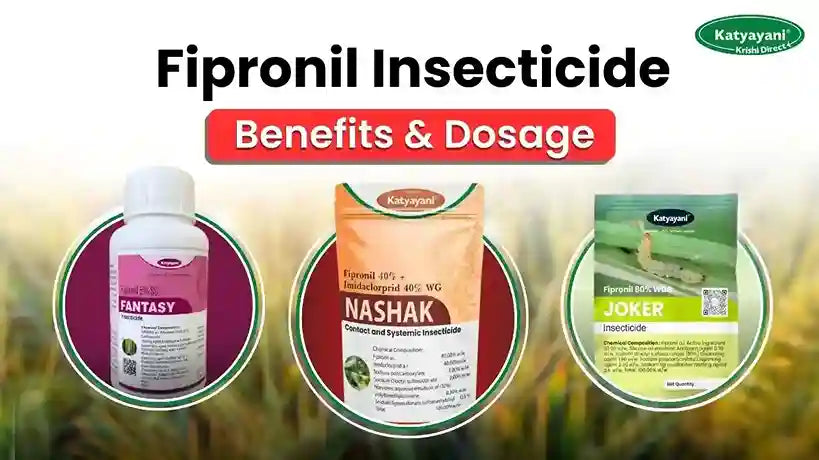

Fipronil insecticide is a phenylpyrazole that blocks nerve signals in insects, so they stop feeding and die. In Indian fields it is used mainly on paddy borers and hoppers, sugarcane shoot borers, thrips in chilli and onion, and soil pests. The dose depends on the formulation and crop, so follow the label.
Updated: October 2026
Most people searching for fipronil insecticide want three things: what it kills, how much to mix, and whether it is safe to use. This guide covers all three using the dose tables printed on Katyayani labels, plus the cautions that matter for bees, fish and resistance.
What is fipronil and how does it work?
Fipronil belongs to the phenylpyrazole group. It blocks GABA-gated chloride channels in an insect's nervous system. Normally these channels calm nerve activity down. With them blocked, the nerves keep firing, the insect shakes, becomes paralysed and dies.
It works by contact and by ingestion, and the spray formulations also move a little inside the plant (systemic action). That is why one product can reach both a stem borer hidden inside the tiller and a hopper sitting at the base of the plant.
Fipronil insecticide is a chemical, not a bio-product. Treat it as one tool inside a wider pest plan: scouting, thresholds, field hygiene, and rotation with other modes of action.
What is fipronil used for?
Fipronil insecticide is used against borers, hoppers, thrips, aphids, gall midge, whorl maggot, diamondback moth and soil pests such as white grub, shoot borer and termites. Which pest you can target depends on the crop printed on the label of the specific product.
- Paddy: stem borer, brown plant hopper, green leaf hopper, white-backed plant hopper, gall midge, whorl maggot, leaf folder.
- Sugarcane: early shoot borer and root borer; white grub with the fipronil + imidacloprid mix.
- Chilli and onion: thrips, and fruit borer in chilli.
- Cabbage: diamondback moth.
- Cotton: aphid, jassid, thrips, whitefly.
- Wheat: termites, through the granular product applied to soil.
If brown plant hopper is your specific problem, the field-level steps are in our guide to brown plant hopper management in paddy (in Hindi).
Fipronil formulations and label doses
The same active ingredient comes in very different packs. A granule goes on the soil, a suspension concentrate goes in the sprayer, and a water-dispersible granule is a concentrated powder you weigh out. Do not swap rates between them.
| Formulation | Crop and target (as per label) | Dose per acre |
|---|---|---|
| 5% SC (liquid, spray) | Paddy: stem borer, hoppers, gall midge, whorl maggot | 400-600 ml |
| 5% SC | Cabbage: diamondback moth; Chilli: thrips, aphids, fruit borer | 320-400 ml |
| 5% SC | Sugarcane: early shoot borer, root borer; Cotton: aphid, jassid, thrips, whitefly, bollworm | 600-800 ml |
| 0.3% GR (granules, soil) | Rice: stem borer, hoppers, leaf folder, gall midge | 7-10 kg |
| 0.3% GR | Sugarcane: early shoot borer, root borer | 10-14 kg |
| 0.3% GR | Wheat: termites | 8-10 kg |
| 80% WG (spray) | Paddy: stem borer, leaf folder (150-200 L water) | 20-25 g |
| 80% WG | Grapes (300-400 L water) and chilli (200 L): thrips | 20-25 g |
| 80% WG | Onion (200 L) and cotton (150-200 L): thrips | 30 g |
| 80% WG | Cabbage: diamondback moth (200 L water) | 38 g |
| 40% + imidacloprid 40% WG | Sugarcane white grub (400-500 L water) | 180-200 g |
| 40% + imidacloprid 40% WG | Groundnut white grub (400 L water) | 100-120 g |
| 40% + imidacloprid 40% WG | Cotton jassid, whitefly (50 g); rice brown plant hopper, yellow stem borer (40-50 g); chilli fruit borer, thrips (30-40 g); each in 200 L water | 30-50 g, by crop |
For brown plant hopper and stem borer in paddy, fipronil 5 sc is the liquid option and covers the widest list of pests on one label. Where borers or termites sit in the soil and at the stem base, the granular fipronil 0.3 gr is applied to the soil instead of sprayed. For thrips in chilli, onion, grapes and cotton, a pack like fipronil 80 wg uses a very small quantity per acre, so weigh it on a scale and do not estimate by eye. For white grub in sugarcane and groundnut, or hopper and borer together in rice, the two-active mix fipronil 40 + imidacloprid 40 is on the label for those crops.
How much fipronil per litre of water?
For the 5% SC label, the small-batch mixing rate is 2-4 ml per litre of water. For the 80% WG, it is 0.2-0.3 g per litre. The acre rate in the table above is still the controlling figure, so do not exceed it just because the mix looks thin.
A practical way to check your mix: take the acre dose, divide by the number of tanks you will spray per acre, then divide by the tank size. The label's own foliar example for the 40+40 WG is 4 g in a 15-litre knapsack. If your numbers disagree with the label for that crop, stop and re-read it.
Water volume matters too. The labels above use 300-500 litres per acre for grapes and soil drenching in sugarcane, and about 150-200 litres for most field crops. Spraying with too little water leaves the lower canopy untouched, which is exactly where hoppers sit.
How long is fipronil active?
There is no single number of days. Katyayani labels describe quick action with long residual effect, but residual time depends on the formulation, soil or leaf surface, rain, temperature and pest pressure. Granules in soil usually last longer than a foliar spray on exposed leaves.
What a farmer can use is a field check, not a calendar. Look at fresh damage 5 to 7 days after treatment. New dead hearts, fresh hopper nymphs or new thrips scars mean the first application did not hold, and the answer is usually to rotate to a different mode of action rather than repeat the same product.
Also respect the pre-harvest interval printed on the label of your pack. Do not harvest or sell vegetables before it ends.
How to use fipronil for termites
In crops, fipronil for termites means soil application of granules. On the Katyayani 0.3% GR label, wheat termites are treated at 8-10 kg per acre, applied to the soil. Termites attack roots underground, so a spray on leaves does nothing for them.
Mounds and patchy wilting in sugarcane or wheat are the usual signs. Treat at sowing or planting time, when the soil has enough moisture for the granules to reach the root zone.
Termite control inside houses and buildings is a different job with different products and licensed applicators. The farm labels in this guide are not meant for that.
Is fipronil a good insecticide?
It is a good option when the pest on your field is on the label and the timing is right. It acts quickly, covers both chewing and sucking pests, and gives a different mode of action from the organophosphates and pyrethroids many farmers rotate against.
It is not a solution for everything. Overuse in one season, repeated sprays of the same group, and spraying below the threshold are how hoppers and borers build resistance. A simple plan helps:
- Spray only when scouting shows damage near the economic threshold.
- Do not use fipronil products repeatedly in the same crop cycle unless the label allows it.
- If a second round is needed, switch to a different mode of action, for example an organophosphate (see chlorpyrifos explained).
- For thrips in particular, compare options in insecticides for thrips before choosing.
Safety: bees, fish and your own protection
Safety note. Fipronil is toxic to honey bees and to fish and other aquatic life. Do not spray flowering crops or weeds while bees are foraging; spray in the evening instead. In paddy, do not let treated water drain into ponds, fish tanks or streams.
- Wear gloves, a full-sleeve shirt, long trousers, a mask and eye protection while mixing and spraying.
- Mix only what you will spray the same day. Wash the sprayer away from water sources.
- Do not eat, drink or smoke during the job. Wash hands and face with soap afterwards.
- Store sealed packs in a cool, dry place, locked, away from children, animals and food.
- If someone feels unwell, call a doctor or the poison helpline immediately and carry the pack label.
Is fipronil banned?
We could not find any order that bans fipronil as a whole in India, so the honest answer is that use is allowed only on the crops and pests registered on the product label. Rules can differ by crop, formulation and state, and some countries have restricted certain uses, which is why the question keeps coming up.
Before you buy any pack, check the registered crops on the label and confirm them on the Central Insecticides Board and Registration Committee (CIB&RC) list. If your crop is not on the label, do not use the product on it.
What to do next
Pick the formulation by where the pest lives: leaves and stems (SC or WG), or soil (GR). Match your crop to the label table, weigh or measure carefully, and note the spray date so you can rotate next time.
If you read Hindi, the same facts are organised differently in the Hindi version of this guide.