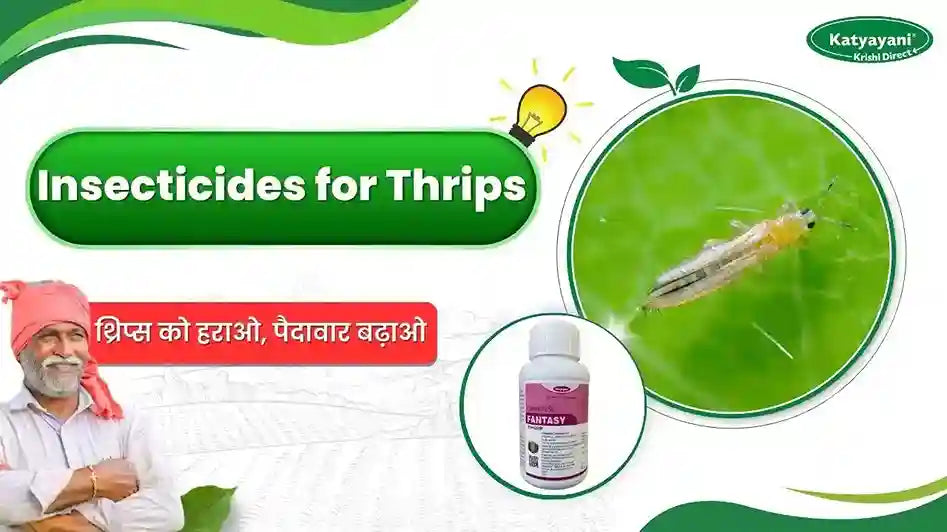

No single insecticide is best for every thrips problem. Spinosad, imidacloprid (systemic), fipronil and emamectin benzoate are the actives most often listed on Indian labels for thrips in chilli, cotton and grapes. Pick the one whose label names your crop and thrips, rotate groups, and spray the underside of leaves.
Updated: October 2026
Thrips are tiny, fast-breeding and good at hiding in flowers and leaf folds. That is why one spray often gives only a short relief. This guide shows what the damage looks like, which active ingredients are used, label doses where Katyayani lists them, and how to keep thrips from coming back.
How do you confirm it is thrips?
Thrips are slender insects about 1-2 mm long, so you rarely see them without tapping the shoot over a white sheet of paper. Look for the damage first.
- Silvery or whitish streaks and patches on leaves, often with tiny black dots (their droppings).
- Leaves curling upward or cupping, especially young leaves in chilli.
- Flower drop, scarred fruit skin and stunted shoots.
- In onion, leaf tips turning white and bulbs staying small. Read more in onion thrips and bulb size (Hindi).
Leaf curl in chilli can also come from mites or a virus. If tapping the shoot gives no thrips, do not spray an insecticide on a guess. Our overview of what is a pest and how to scout for one explains basic scouting.
Which insecticide works on thrips?
Insecticides based on spinosad, imidacloprid, fipronil and emamectin benzoate have thrips listed on the Katyayani labels, and the table shows each label dose. A product should be used only on the crops and for the pest written on its own label.
| Active ingredient | How it works | Where the label lists thrips | Label dose (Katyayani) |
|---|---|---|---|
| Spinosad 45% SC | Contact and ingestion; nerve excitation | Chilli, grapes | Chilli 55-65 ml per acre; grapes 100 ml per acre |
| Imidacloprid 70% WG | Systemic; translaminar | Cotton, okra, tomato | Cotton and okra 12-15 g per acre; tomato 20 g per acre |
| Imidacloprid 30.5% SC | Systemic | Cotton, chilli | Cotton 24-30 ml per acre; chilli 50-60 ml per acre |
| Fipronil 5% SC | Systemic, contact and stomach action | Chilli, cotton | Chilli 320-400 ml per acre; cotton 600-800 ml per acre |
| Emamectin benzoate 5% SG | Nerve action; mainly chewing pests, also thrips on label | Chilli, grapes | Chilli 80 g and grapes 88 g, each in 200 litres of water (label table) |
| Verticillium lecanii (bio) | Fungus infects the insect | Chilli and other crops | Foliar 5-10 ml per litre (domestic use); soil 1-2 litres per acre |
Acephate, thiamethoxam, pyrethroids and some other actives also appear in recommendations for thrips. Registered crops differ, so check the pack and the CIB&RC register before using them. Doses above come from product labels and should not be exceeded.
For thrips in chilli, you might use spinosad 45 sc, which works on contact and by ingestion, and is a different chemical group from imidacloprid, making it a sensible rotation partner.
Is imidacloprid good for thrips?
Yes, imidacloprid is a widely used systemic insecticide for thrips, aphids, jassids and whitefly, and Katyayani labels list thrips in cotton, okra, tomato and chilli. Systemic means the plant takes it in, so thrips feeding on the leaf are reached even where the spray did not land.
Its weakness is repetition. Many fields have had imidacloprid every season for years, and thrips can become less sensitive to it. A systemic option such as imidacloprid 70 wg is a fit for cotton, okra and tomato, but use it once per cycle at most, then change the group. It is also toxic to bees, so avoid spraying open flowers or when bees are active.
Fipronil is the other systemic choice on the label for chilli and cotton. Our guide to fipronil uses and dosage covers it in detail.
Best insecticide for thrips in chilli, cotton, onion and grapes
For each crop, the answer is a short list of labelled options plus a rotation, not one product.
| Crop | Typical thrips and damage | Options with thrips on label |
|---|---|---|
| Chilli | Chilli thrips; upward curl, silvering, flower drop | Spinosad, imidacloprid, fipronil, emamectin; rotate and add bio-control |
| Cotton | Early-season thrips on seedlings; leaf curl and slow growth | Imidacloprid, fipronil |
| Grapes | Flower and berry scarring | Spinosad, emamectin benzoate |
| Okra, tomato | Leaf curl, flower drop, tomato spotted wilt virus risk | Imidacloprid 70 WG |
| Onion, garlic | Silver streaks, white tips, small bulbs | Check the label of the product for onion; no onion dose is listed above |
Onion is covered in the Hindi post linked above. For chilli specifically, the sequence usually works better than any single spray: a systemic product at the first sign of curl, a different group seven to ten days later if thrips are still present, and a bio product in between.
Does neem spray kill thrips? What about bio-pesticides?
Neem helps, but it is a slow, weaker option, not a quick knockdown. Azadirachtin in neem oil reduces feeding and disrupts growth, so it works best on small populations and young thrips. For heavy infestation, neem alone will not rescue the crop.
Neem oil lists thrips, aphids, whitefly and jassids as targets on its label. The fungus Verticillium lecanii infects thrips and other sucking pests and does best in humid weather, so it is useful in seedlings, nurseries and between chemical sprays. You can read the label for Verticillium lecanii for its soil and foliar doses.
Biological sprays and chemical fungicides should not go in the same tank. Fungicides can kill the fungal spores in the bio-product.
Non-chemical steps that cut thrips numbers
- Blue sticky traps. Thrips are attracted to blue. Hang traps just above the crop canopy as a monitoring tool; about 10-15 per acre is a general starting point.
- Reflective or silver mulch. It confuses thrips landing on young plants and is used in chilli and vegetables.
- Weed control. Weeds along bunds hold thrips between crops.
- Avoid water stress and heavy nitrogen. Thrips multiply fast in dry weather, and soft, lush growth suits them.
- Remove badly affected plants in nursery beds before transplanting.
- Do not plant chilli next to onion or cotton if you can avoid it. They share thrips.
How to spray so it actually works
- Spray in the early morning or evening. Thrips hide in the middle of the day, and heat reduces residue.
- Cover the underside of the leaves, growing tips and open flowers. Most of the population sits there.
- Use enough water for full coverage and add the product only as the label allows.
- Mix a small test batch before combining two products.
- Check the crop after 3 to 4 days. If many live thrips remain, do not repeat the same product. Switch group.
Safety note: Wear gloves, a mask and full sleeves. Follow the label for pre-harvest interval, especially on chilli and vegetables that are picked often. Keep spray away from open bee-visited flowers, and keep containers away from children and animals. After any accidental exposure, call a doctor or the poison helpline immediately and take the label with you.
Rotation and resistance: why the same spray stops working
Thrips breed in a week or two, so a population can see many generations in a season. If every spray belongs to the same chemical group, survivors pass on tolerance. The fix is simple.
- Use one group per spray window and change group for the next.
- Do not increase the dose beyond the label.
- Keep bio sprays and traps in the programme so that chemicals are used less often.
- Where two sprays are needed, use a different active such as spinosad after imidacloprid or fipronil.
For caterpillar pests that show up together with thrips on chilli, our guide to emamectin benzoate 5 sg (in Hindi) covers the label crops.
What to do this week
Tap five shoots in different corners of the field over white paper. If you count more than a few thrips per shoot, start with the cultural steps and one labelled spray in the evening. Write the product group on your notes so the next spray is a different one. If curling continues with no thrips, call your KVK or the Kisan Call Centre on 1800-180-1551 for an on-field diagnosis.