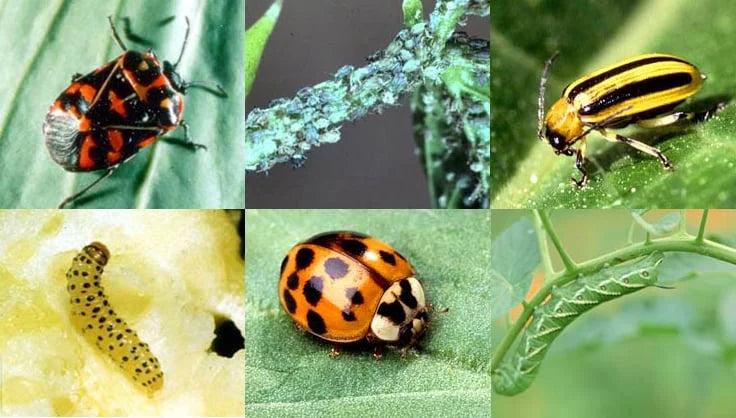

A pest in agriculture is any living organism that damages crops, stored produce or livestock enough to cause economic loss. Insects, mites, nematodes, rodents, birds, weeds and disease-causing microbes are all counted. An insect becomes a pest only when its numbers cross the level where damage costs more than control.
Updated: October 2026
So, what is a pest in agriculture, and who decides? Not every insect in your field is a problem. Ladybirds, spiders and bees help the crop. This guide explains what makes an organism a pest, the main types, ten common Indian examples, and the order in which farmers should act.
What is a pest in agriculture? A simple definition
A pest is an organism that competes with people for food, fibre or feed, or harms them, and causes loss that matters economically. The word describes a relationship, not a species. A caterpillar eating a few leaves of a wild shrub is just an insect. The same caterpillar in a tomato field with fruit being bored is a pest.
In biology classes you may also see "pest" used for any organism that is unwanted by humans, such as cockroaches in a house or rats in a godown. In agriculture, the definition is tied to crop loss, yield quality and cost of control.
For school and Class 5 level, the short answer is: a pest is a small animal or plant that harms crops or stored grain.
What are the four types of pests?
There is no single official list. Textbooks differ, so the "four types" you see depends on the book. The most common school version is:
- Insects and mites: aphids, caterpillars, borers, whiteflies, red spider mite.
- Weeds: unwanted plants that compete for light, water and nutrients.
- Plant pathogens (disease-causing organisms): fungi, bacteria, viruses.
- Vertebrate pests: rats, birds, wild boar, monkeys, nilgai.
Other sources split nematodes (microscopic roundworms in soil) and snails and slugs into separate groups. A farmer does not need to memorise the list. What matters is that each group is managed in a different way.
What are the types of insect pests?
Insect pests are usually grouped by how they feed, because the damage and the control method follow from it.
| Feeding type | How they feed | What you see on the crop | Examples |
|---|---|---|---|
| Chewing | Bite and eat leaves, fruits, grain | Holes, ragged leaves, missing leaf area | Caterpillars, grasshoppers, beetles |
| Piercing and sucking | Pierce tissue and drink sap | Yellowing, curling, sticky honeydew, sooty mould | Aphids, jassids, whitefly, planthoppers |
| Rasping and sucking | Scrape the surface and drink the oozing sap | Silvery streaks, curled leaves | Thrips |
| Boring | Larvae tunnel inside stems, fruits, pods | Dead heart, entry holes with frass | Stem borers, fruit borers, pod borers |
| Root feeding | Feed on roots and tubers underground | Wilting, plants pull out easily | White grubs, termites |
| Stored-grain feeding | Feed inside or on stored grain | Holes in grain, powder, webbing | Rice weevil, khapra beetle |
10 examples of crop pests with damage signs
These are well-known pests in Indian farming. Pictures will be added to this page.
| Crop | Pest | Type | Damage sign |
|---|---|---|---|
| Rice | Brown planthopper | Sucking | Circular patches that dry up, called hopper burn |
| Rice | Yellow stem borer | Boring | Dead heart in young plants, white ear in older ones |
| Cotton | Pink bollworm | Boring | Rosette flowers, damaged bolls with stained lint |
| Cotton | Whitefly | Sucking | Honeydew, black sooty mould; also spreads leaf curl virus |
| Chilli | Thrips | Rasping and sucking | Upward leaf curl, silvery streaks, flower drop |
| Mustard | Aphid | Sucking | Clusters on twigs and pods, sticky leaves |
| Tomato | Fruit borer (Helicoverpa) | Chewing and boring | Round holes in fruit, caterpillar inside |
| Cabbage | Diamondback moth | Chewing | Small holes and windowing on leaves |
| Maize | Fall armyworm | Chewing | Ragged leaves, sawdust-like frass in the whorl |
| Sugarcane | Early shoot borer | Boring | Dead heart that pulls out easily |
This list could be much longer, because every crop has its own set of pests. Learning what is a pest in agriculture for your own crop starts with the damage sign. For a Hindi list of the chemicals used against some of these, see कीटनाशक दवा के नाम और चुनने का तरीका, and for one of the sucking pests in the table, best insecticide for thrips.
Pest, disease and weed: what is the difference?
The three are often mixed up because they all reduce yield, but they are managed differently.
- Pest: usually an animal, such as an insect, mite, nematode, rodent or bird. It eats, sucks or bores the crop.
- Disease: caused by fungi, bacteria or viruses living in the plant. Symptoms are spots, rot, wilt or mosaic. Fungicides and resistant varieties are the tools.
- Weed: a plant growing where it is not wanted. It competes with the crop and may host pests.
Some insects are also disease carriers. Whitefly spreads leaf curl virus in cotton, chilli and tomato, so one pest can bring a disease.
When does an insect become a pest? The economic threshold idea
An insect turns into a pest when its numbers pass the economic injury level. That is the density at which the loss from damage equals the cost of controlling it. The economic threshold level (ETL) is set a little lower. It is the number at which you should act so that the population does not reach the injury level.
In practice, ETL is a tool for deciding whether to spray at all. Official recommendations from state agriculture universities give crop-wise ETLs, for example how many larvae per plant or per metre of row. Those numbers change with the crop, stage and region, so take them from your state university or KVK rather than from a general article. The idea (Stern and colleagues, 1959) is the basis of integrated pest management.
How to control pests: the IPM ladder
Integrated pest management (IPM) means using several methods in order, with chemicals as the last step, not the first.
- Cultural: crop rotation, clean seed, correct sowing time, balanced fertiliser, field sanitation, removing alternate weed hosts.
- Mechanical and physical: hand picking egg masses, light traps, sticky traps, bird perches, nets.
- Biological: natural enemies (parasitoids, ladybirds, spiders) and microbial products such as Beauveria, Verticillium, Metarhizium, Bacillus thuringiensis and neem.
- Chemical: a labelled insecticide, used only when the ETL is crossed, at label dose, with rotation of groups. For one such chemical group and its label crops, see fipronil insecticide uses and dosage.
On the biological step, neem oil is commonly used early, when aphids, whitefly or thrips are few. Its label lists these along with jassids and spider mites. A fungal mix like Triple Attack is used as a biological alternative for sucking and chewing pests, and its label gives 2 litres per acre for foliar or soil use.
Safety note: Whichever product you use, read the label for crop, dose and the waiting period before harvest. Wear gloves and a mask, keep sprays away from flowering plants that bees visit, and store containers away from children and food.
Simple field monitoring
You cannot judge a pest from the field bund. Walk the field every 4 to 5 days.
- Check five spots in a zigzag pattern, about 20 plants in total, instead of only the border rows.
- Turn leaves over and look at the underside, the growing tip and flowers.
- Use yellow or blue sticky traps for whitefly, aphids and thrips. Use pheromone traps for moths such as pink bollworm or fruit borers to learn when adults arrive.
- Count also the helpful insects. A field with many ladybirds and spiders may not need a spray.
- Note the date, crop stage and what you found. Next season, you will know when the pest usually arrives.
Where to start
Pick one crop you grow and write down its three most common pests and the month they usually appear. Then set up traps and a weekly walk a fortnight before that month. If you find a pest you cannot name, take a leaf and a photo to your nearest KVK. Naming the pest is the first step in controlling it.